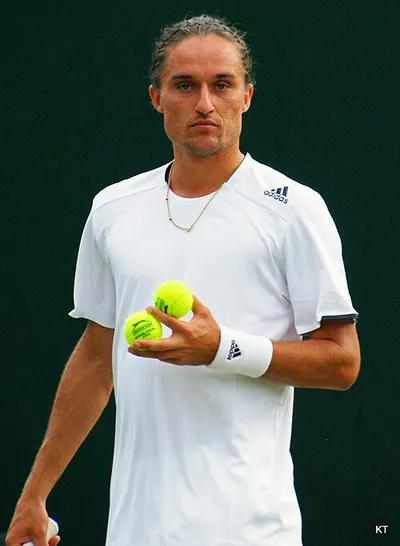

Alexandr Dolgopolov
Ukrainian former tennis player, Australian Open quarterfinalist in 2011 and world No. 13 in January 2012
The Big Three eraBiography
Alexandr Dolgopolov (born 7 November 1988 in Kyiv) is a retired Ukrainian professional tennis player who competed on the ATP Tour from 2006 until 2018, when he played his final match in Rome. He announced his retirement in 2021. He belonged to a group of unorthodox players who reached the top of the sport in the early 2010s. His best Grand Slam performance came at the 2011 Australian Open, where he reached the quarterfinals, and in January 2012 he reached No. 13 in the world, his career-high singles ranking.
He was born in Kyiv when the city was part of the Soviet Union. His father, Oleksandr Dolgopolov, had been a professional player and later coached Andrei Medvedev, then Ukraine's most successful player. His mother was a former gymnast. The family spent part of his childhood in New York, and he began playing at three under his father's guidance. As a toddler he travelled with his parents to tournaments, which gave him early contact with players of that era.
His international career started in 2005, when he played junior ITF events and Futures. That year he reached the quarterfinals of the junior French Open and climbed to No. 21 in the junior world rankings at only 16. In 2006 he won five Futures titles in Egypt, Ukraine, Belarus and Italy, which took him inside the world's top 400. That year he made his ATP debut as a qualifier in Bucharest, losing in the first round to Christophe Rochus. Soon afterwards he was picked for Ukraine's Davis Cup tie against Great Britain, where Andy Murray beat him.
In 2007 he lost in qualifying at several Grand Slam events, but he won his first Challenger in Sassuolo, Italy, beating Héctor Ruiz-Cadenas in the final. That same year he lost to Greece's Alexandros Jakupovic in his second Davis Cup tie. The 2008 season was hard: he rarely got into main draws and dropped to No. 470 in September. He recovered in 2009, winning the Challengers in Orbetello, Como and Trnava, and in October he claimed his first ATP main-draw win in St Petersburg. That year he also parted ways with his father and hired Australian coach Jack Reader, and he changed the spelling of his name to Alexandr. The two men did not speak for a period but later reconciled.
2010 marked his full arrival on the tour. At Roland Garros he reached the third round after beating twelfth seed Fernando González in straight sets, the biggest win of his career up to that point. On grass he reached the Eastbourne semifinals, where Michaël Llodra beat him after he had led 4-1 in the second set, and at Wimbledon he lost in the second round to Jo-Wilfried Tsonga in five sets. On clay he won a Challenger in Meknes, beating Rui Machado in the final.
2011 was his best season. In Sydney he reached the quarterfinals, and at the Australian Open he beat Tsonga, the player who had beaten him at Wimbledon, and then fourth seed Robin Söderling before losing to Andy Murray in four sets in the quarterfinals. He then played the South American clay swing, where he reached the final in Costa do Sauípe and lost to Nicolás Almagro, and he reached the semifinals in Acapulco. At Indian Wells, partnering Xavier Malisse, he won the doubles title, beating Roger Federer and Stanislas Wawrinka in the final after a super tiebreak. In Miami he reached the fourth round and lost to Rafael Nadal. His European clay season was patchy, with several early exits, though he reached the quarterfinals in Nice. At Roland Garros he lost in the third round to Viktor Troicki in four sets. On grass his results were more modest, but in Umag he won his first ATP singles title, beating Marin Čilić in three sets in the final. At the US Open he reached the fourth round, where Novak Djokovic won a first-set tiebreak 16-14 on the way to a straight-sets win.
Dolgopolov played an unorthodox, all-court game. He could defend from the baseline but also attacked often and volleyed well. His serve had a quick rhythm with very little pause in the motion, and his forehand, hit with a jumping topspin, could pull opponents off the court. Commentators compared his variety of pace and spin to Andy Murray's and his inventive shot-making to that of Fabrice Santoro. For much of his career he preferred clay to protect his knees, but as he matured he felt more at home on hard courts. In 2012 he won the Citi Open in Washington, an ATP 500 event, beating Tommy Haas in the final, and he lost the Brisbane final to Andy Murray. In 2017 he won the Argentina Open in Buenos Aires, his third ATP title. Representing Ukraine at the 2016 Hopman Cup with Elina Svitolina, he reached the final, where Nick Kyrgios beat him in the singles rubber.
Dolgopolov lived with Gilbert's syndrome, an inherited condition affecting the liver and blood that caused fatigue and worsened with long-haul travel. It required intravenous treatment and a supervised diet. After Russia's full-scale invasion of Ukraine in 2022 he enlisted in the Ukrainian armed forces and served as a drone operator. His career is one of brilliance in flashes and inconsistency over time, and it remains a distinctive example of a player who stood out through style rather than consistency.
Career timeline: titles, finals and medals
1 title
- 2011
Main achievements
- Australian Open quarterfinalist (2011).
- World No. 13 in singles (January 2012).
- Citi Open champion, an ATP 500 title (2012).
- Umag champion (2011), his first ATP singles title.
- Argentina Open champion (2017).
- Indian Wells Masters doubles champion (2011), with Xavier Malisse.
- Hopman Cup finalist (2016), with Elina Svitolina.
Trivia
A memorable tiebreak
At the 2011 US Open he took Novak Djokovic to a first-set tiebreak, which Djokovic won 16-14.
A coach father
His father had coached Andrei Medvedev, Ukraine's most successful player at the time, before becoming Alexandr's own main coach.
Two spellings of a name
In 2009 he changed the spelling of his first name from Oleksandr to Alexandr.
Players of the same era
 Roger FedererSwitzerland 1981
 Rafael NadalSpain 1986
 Novak DjokovicSerbia 1987
 Serena WilliamsUnited States 1981
 Maria SharapovaRussia 1987
 Venus WilliamsUnited States 1980
 Andy MurrayUnited Kingdom 1987
 Martina HingisSwitzerland 1980
 Victoria AzarenkaBelarus 1989
 Kim ClijstersBelgium 1983
 Angelique KerberGermany 1988
 Caroline WozniackiDenmark 1990