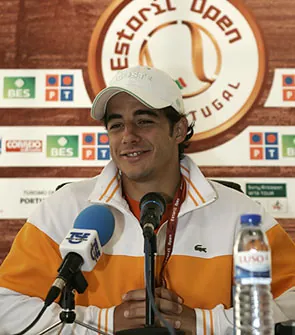

Frederico Gil
Portuguese tennis player, former world No. 62 in singles and a key figure for Portugal's Davis Cup team
The Big Three eraBiography
Frederico Gil (born 24 March 1985 in Lisbon) is a Portuguese tennis player who competed on the professional circuit from 2003. His career-high singles ranking was world No. 62, reached in 2011, which made him the highest-ranked Portuguese player in history until Rui Machado surpassed him later that same year. His importance goes beyond the numbers: his results revived interest in tennis in Portugal and made him the main figure of the national Davis Cup team.
He was born in São Jorge de Arroios, in Lisbon. His father, Rui, worked for an insurance company, and his mother, Carlota, is a maths teacher. He has a younger sister, Ana. He started playing at the age of four on a court built on the family grounds, and at seven he joined a local club, where he won his first tournament shortly afterwards. At ten he was diagnosed with osteochondroma and advised to give up tennis. Three years later he had recovered and resumed training with the aim of becoming a professional. In 2003 he joined the Clube Escola Ténis de Oeiras, led by João Cunha e Silva, who would coach him for much of his career. His father played professional football for Benfica, a club Gil has always followed.
His junior career began in 2000 with his first appearance in a main draw, in doubles. His first title came in March 2001 in Panama, also in doubles, and his first singles title arrived in February 2002 in Bolivia. Up to his final junior event in December 2003, he had won three singles titles from six finals and six doubles titles from eight. At Grade A events he came close to the top: he was runner-up in singles at the Banana Bowl in 2003, won the doubles there in 2002 and 2003, and reached the singles quarter-finals at the Orange Bowl. He finished 2003 as world junior No. 10. That year he also turned professional, entering his first Futures main draw in Espinho.
His first professional seasons were a period of learning. In 2004 he won his first Futures doubles title, in Lagos, and made his ATP debut at the Estoril Open in doubles with Bernardo Mota, reaching the quarter-finals. That year he was called up for the Davis Cup for the first time, winning his matches against Tunisia in April. In 2005 he collected singles titles on the Futures circuit in Faro, Lagos and Caracas, and entered a Challenger main draw for the first time, in Tolyatti. In Davis Cup he won six of seven matches against Estonia, Algeria and Slovenia, helping Portugal climb to the Europe/Africa Group I.
In 2006 he made his singles ATP debut at Estoril. He beat David Luque-Velasco in the first round and, in the second, Dmitry Tursunov, then world No. 33. He lost in the quarter-finals to David Nalbandian, then world No. 4, who went on to win the tournament. That year he won his first Challenger singles titles, in Sassuolo in June. In 2007 he made his first attempt to enter the Roland Garros draw, but lost in the final round of qualifying. He also played his first ATP event outside Portugal, the Grand Prix Hassan II, and at Estoril he lost to Richard Gasquet. The Challenger Tour was his main stage that season, with a singles title in Seville and four doubles finals. Portugal, however, were relegated in the Davis Cup after losing all five of their matches against Georgia and the Netherlands.
2008 brought his first Grand Slam appearances. After starting the season on the Challenger Tour, he qualified for Roland Garros and lost in the first round to Jérémy Chardy. At Estoril he reached the quarter-finals for the second time in his career, after wins over Nicolas Mahut and João Sousa, and lost in straight sets to Roger Federer, then world No. 1. At Wimbledon he qualified again and lost in the first round to Chardy, though he reached the second round in doubles with Dick Norman. That summer he added Challenger titles in Istanbul in singles and in Turin in doubles. These results took him into the ATP top 100, making him the second Portuguese player to get there after Nuno Marques, and he equalled Marques's best position, No. 86. He finished the year at No. 110.
The 2009 season consolidated his place on the ATP Tour. He opened it with two semi-finals in a row: at the SA Tennis Open he beat Guillermo García López and lost to Jo-Wilfried Tsonga, and at the Brasil Open he beat world No. 18 Nicolás Almagro before losing to Thomaz Bellucci. These results lifted him to No. 82, a new career best and a new record for a Portuguese player. In Miami, his first Masters 1000 event, he reached the third round after beating Mischa Zverev and Ivo Karlović, and lost to Rafael Nadal. He was No. 70 in April. That year he was also the first Portuguese to enter the Estoril main draw directly on ranking, though he lost in the first round to James Blake. At Roland Garros he lost to David Ferrer, and at Queen's to Lleyton Hewitt. He ended the season at No. 69, the best year-end ranking by a Portuguese player up to that point.
The high point of his career came in 2010. At the Estoril Open he beat four higher-ranked opponents, including Rui Machado and, in the semi-finals, Guillermo García López, to become the first Portuguese player to reach an ATP singles final. There he lost to Albert Montañés, after letting a 3-0 lead in the final set slip away. Shortly afterwards he won a Challenger singles title in Milan and a doubles title in Lugano, though he lost in the first round at Wimbledon to Marcel Granollers. At the US Open, partnering Daniel Gimeno Traver, he reached the third round of a Grand Slam for the first time, in doubles. His wins over Bosnia and Herzegovina in the Davis Cup helped Portugal move up to Group I for 2011. He ended that year at No. 101, behind Machado.
In 2011 he won his first match at a Grand Slam singles event. At the Australian Open he beat Pablo Cuevas in five sets, becoming the first Portuguese player since Nuno Marques in 1991 to do so at that event. In Monte-Carlo he beat Gaël Monfils, the eighth seed, and reached the quarter-finals of a Masters 1000 for the first time, where he lost to Andy Murray. That season he climbed to No. 62 in the world after reaching the quarter-finals in Naples on the Challenger circuit. At Roland Garros he lost in the first round to Marcos Baghdatis, and at Wimbledon to Dudi Sela. At the US Open he lost in the first round to Alexandr Dolgopolov. In November he reached the quarter-finals in Buenos Aires, where he lost a match in which he had led, against his friend Gastão Elias.
In 2012 he was again at his best at the Australian Open. After beating Ivan Dodig in the first round, he defeated Marcel Granollers in four sets and became the first Portuguese tennis player to reach the third round of a Grand Slam. There he lost to world No. 6 Jo-Wilfried Tsonga in three sets. After that tournament he returned to the top 100. At the VTR Open in Viña del Mar he beat Paolo Lorenzi and fourth seed Pablo Andújar, dominating the Spaniard on return, before losing in the quarter-finals to Jérémy Chardy. His game, built on a solid baseline style and a dependable return, suited clay best, the surface he preferred.
Gil is now one of the most recognisable names in Portuguese tennis. After his time on the professional circuit he has played on the veterans' tour, where he is listed at the top of the ITF Masters 40+ ranking. His legacy lies mainly in what he opened up for his compatriots: a path beyond qualifying for the big tournaments, a reference point in the Davis Cup, and proof that a Portuguese player could compete on level terms on the ATP Tour.
Main achievements
- Runner-up at the Estoril Open (ATP), singles, 2010
- Career-high singles ranking: world No. 62, 2011
- Quarter-finalist at the Monte-Carlo Masters 1000, 2011
- Third round at the Australian Open, 2012
- Challenger singles titles in Sassuolo (2006 and 2008), Istanbul (2008), Naples (2009) and Milan (2010)
- Challenger doubles titles in Marrakech and Turin (2008), Naples (2009) and Lugano (2010)
- Contributed to Portugal's promotions to Davis Cup Group I in 2005 and 2010
Trivia
An American idol
As a boy he idolised Andre Agassi. His hobbies include computers, video games and golf.
A first for Portugal in prize money
He was the first Portuguese player to earn one million dollars in career prize money.
A diagnosis at ten
He was diagnosed with osteochondroma at ten and advised to stop playing. Three years later he had recovered and returned to training.
Players of the same era
 Roger FedererSwitzerland 1981
 Rafael NadalSpain 1986
 Novak DjokovicSerbia 1987
 Serena WilliamsUnited States 1981
 Maria SharapovaRussia 1987
 Venus WilliamsUnited States 1980
 Andy MurrayUnited Kingdom 1987
 Martina HingisSwitzerland 1980
 Victoria AzarenkaBelarus 1989
 Kim ClijstersBelgium 1983
 Angelique KerberGermany 1988
 Caroline WozniackiDenmark 1990