

George Hillyard
British tennis player, Olympic doubles champion in London 1908 and secretary of the All England Club
The origins- Born
- February 6, 1864
- Died
- March 24, 1943
- Country
- United Kingdom
- Official profiles
- ATP · ITF
Biography
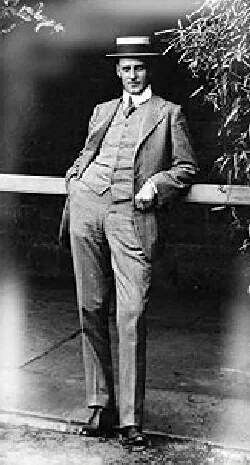
George Whiteside Hillyard (Hanwell, Middlesex, 1864 - Pulborough, West Sussex, 1943) was a British tennis player of the Victorian and Edwardian era. He is best remembered for winning the men's doubles at the 1908 London Olympics, for his long service as secretary of the All England Club from 1907 to 1925, and for helping to move Wimbledon to its present home on Church Road. His story also brings together competitive sport, tournament administration and the promotion of a new court surface.
Hillyard was born in Hanwell, the only child of George Wright Hillyard, a former police officer who later worked in a Nottinghamshire prison and then ran a school in west London, and of his second wife, Mary Mansfield. In 1877, aged thirteen, he entered the Britannia Royal Naval College as a cadet. He became a midshipman in 1879 and between 1880 and 1882 took part in a naval voyage around the colonies of the British Empire, sharing the midshipmen's berth with Princes Albert and George, the future King George V. He left the Navy in 1885 as a sub-lieutenant. He had first met tennis at the age of ten, through an uncle who had built a sphairistike court in 1875, but at first he preferred cricket, which absorbed much of his youth.
His serious commitment to tennis came after his naval service, when the rules of the game had changed considerably and it began to appeal to him. From 1887 he started entering tournaments. That same year, on 13 July, he married Blanche Bingley at Greenford, a week after the Wimbledon final. Blanche, the daughter of a prosperous London tailor, was a strong player in her own right: she had won Wimbledon in 1886 and would take five more singles titles there before 1900. Only five days after the wedding the couple played the Middlesex Championships at Chiswick Park and won the mixed doubles.
Hillyard made his Wimbledon singles debut in 1889 and lost in the quarter-finals to Harry Barlow in straight sets. That year, and again in 1890, he reached the Wimbledon doubles final with Ernest Lewis. They lost the first to the Renshaw brothers and the second to Joshua Pim and Frank Stoker. With Harry Scrivener he took the doubles at the British Covered Court Championships in 1890 and 1891. For a few years cricket drew his attention again, with Leicestershire, but in 1896 he returned fully to tennis and at Monte Carlo won the singles, doubles, handicap and mixed doubles, the last with his wife.
In 1897 he won the first International German Championships in Hamburg, beating George Ball-Greene in the final in five sets, and he repeated the feat there in 1900. At Wimbledon, early defeats in the main draw were partly balanced by the All England Plate in 1898 and a final appearance in 1899. In 1901 he beat Laurence Doherty in the third round before falling in the quarter-finals to Arthur Gore. No detailed accounts survive of his strokes or tactics, so his style can only be judged through his results, especially in doubles, where he was most successful.
In 1905, at 41, he lost the Championship of Europe final at Bad Homburg to Anthony Wilding. A year later he entered Wimbledon but conceded a walkover to Gore and did not play. When he was appointed secretary of the All England Club in 1907 he stopped competing at Wimbledon, though he continued to play minor events such as those at Eastbourne, Yorkshire and Leicester until 1914. After the Great War, at 55, he won the mixed doubles at his home tournament in Leicester with Gladys Lamplough.
At the 1908 London Olympics he won the doubles gold with Reginald Doherty. Yet, although he was a keen admirer of the Games in general, he had reservations about tennis being part of them. In his 1924 book Forty Years of First Class Lawn Tennis he dismissed the Olympic tournament as close to a farce and asked why it was tolerated when the Davis Cup already existed. His cricket career was just as demanding: he captained the Navy side for two years, made his Middlesex debut against the Marylebone Cricket Club in 1886 and played 49 first-class matches in all. He toured North America with Lord Hawke's sides in 1891-92 and 1894, and after 1896 he largely left cricket behind.
In 1896 the couple moved into a large house with extensive grounds at Thorpe Satchville, near Leicester. It had nine bedrooms, two tennis courts and a nine-hole golf course. They hosted lively house parties for champions such as Norman Brookes, Harold Mahony, Anthony Wilding, May Sutton, Violet Pinckney and Dora Boothby, and until 1914 almost every leading overseas player who competed at Wimbledon stayed with them. In 1909 Hillyard met Claude Brown, who ran a nearly bankrupt brickworks at Syston, and the two worked on a surface made of crushed brick. The first court was laid at Thorpe Satchville and named En-tout-cas after a French guest's remark. The business grew rapidly, and by 1922 en-tout-cas courts had been laid alongside the grass courts at the new Wimbledon.
As secretary of the All England Club, from 1907 to early 1925, Hillyard looked after the running of the tournament and, above all, the upkeep of the grass courts. In 1910 the club bought a motor roller to replace the horse roller. Wimbledon's growth made a move from Worple Road to a larger site necessary; the question was discussed from 1907, but finding a suitable location and the war delayed it. From 1914 to 1918 he was back in the Navy, leaving as a commander. The decision to build the new ground was confirmed in 1919, and the Church Road site opened at the 1922 Championships, working with the architect Stanley Peach. From 1919 to 1932 he also umpired every ladies' final at Wimbledon. His link with En-tout-cas was looser than his public role: he was a director of the company, something he later acknowledged, and in 1929 a golf course contract went to the firm on his recommendation.
In 1925, at 61, he resigned as secretary of the All England Club and sold his house at Thorpe Satchville. The couple moved to Bramfold, in Pulborough, where he again built two tennis courts but concentrated on golf. On his initiative a new course was completed at West Sussex Golf Club and opened on 8 August 1930. He died at home in March 1943, aged 79. His wife Blanche survived him by three years. They had two children: Jack, who also played tennis at Wimbledon in the 1920s and reached the All England Plate final in 1924, and Marjorie, who spent the rest of her life in a care home in West Sussex. His legacy is tied to the Wimbledon site that is still used today and to a court surface that spread far beyond Britain.
Career timeline: titles, finals and medals
1 title · 1 medal · 3 lost finals
- 1889
- 1890
- 1896Champion Monte-Carlo MastersMen's singles · vs Victor Voss · 6–3, 6–2, 6–3
- 1902
- 1908Gold Olympic Games · LondonMen's outdoor doubles
Main achievements
- Olympic men's doubles champion, London 1908, with Reginald Doherty
- Wimbledon men's doubles finalist, 1889 and 1890, with Ernest Lewis
- British Covered Court Championships doubles champion, 1890 and 1891, with Harry Scrivener
- Monte Carlo champion in singles, doubles, handicap and mixed doubles, 1896
- Winner of the first International German Championships, Hamburg, 1897, and of the 1900 edition
- Championship of Europe finalist, Bad Homburg, 1905
- Secretary of the All England Club, 1907-1925
Trivia
A name from a guest
The crushed-brick surface was named En-tout-cas, meaning in all cases, after an idea put forward by a French guest at Thorpe Satchville.
From cricket to tours
Hillyard played 49 first-class matches and joined Lord Hawke's tours of North America, combining the two sports at a high level.
A naval prelude
Before devoting himself to tennis he served in the Royal Navy, where he captained the cricket side and later returned as a commander during the First World War.
Players of the same era
 Edwin FlackAustralia 1873–1935
 John Pius BolandUnited Kingdom 1870–1958
 Lottie DodUnited Kingdom 1871–1960Dimitrios Kasdaglis1872–1931Dimitrios KasdaglisGreece 1872–1931
 Reginald DohertyUnited Kingdom 1872–1910
 Momčilo TapavicaHungary 1872–1949
 William RenshawUnited Kingdom 1861–1904
 Hedwig RosenbaumBohemia 1864–1939George S. Robertson1872–1967George S. RobertsonUnited Kingdom of Great Britain and Ireland 1872–1967
 Arthur GoreUnited Kingdom 1868–1928
 Blanche BingleyUnited Kingdom 1863–1946
 Ernest RenshawUnited Kingdom 1861–1899