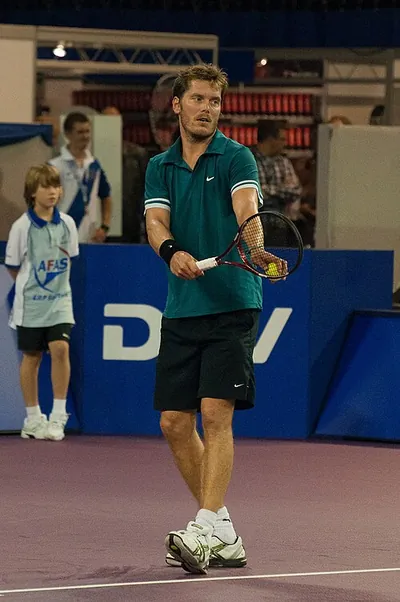

Thomas Enqvist
Swedish former tennis player, runner-up at the 1999 Australian Open and world No. 4 in the ATP rankings
Power and diversityBiography
Thomas Enqvist (born 13 March 1974, Stockholm) is a former Swedish professional tennis player who was among the leading players in the world for much of the 1990s and early 2000s. He competed in the same era as Pete Sampras, Andre Agassi, Jim Courier and Yevgeny Kafelnikov, and he is remembered for holding his own against them at the top level, reaching the final of the 1999 Australian Open and briefly holding the world No. 4 ranking later that year.
Enqvist grew up in Stockholm, the son of an engineer father, Folke, and an economist mother, Birgitta. He started playing at the age of five at the Farsta Tennis Klubb. His junior career was successful: he became Sweden's top junior, won the junior titles at the Australian Open and Wimbledon, and was ranked the world's best junior in 1991, the year he turned professional.
The early seasons as a professional were a period of consolidation. Between 1991 and 1994 he developed his game and climbed the rankings without yet reaching the highest level of results. The breakthrough came in 1995, when ATP players voted him the most improved player of the year after he climbed from No. 60 to No. 7. That season he became a regular in the main draws of the biggest events and began reaching semifinals and finals on the second tier of the tour, which built his confidence against the best players.
In 1996 he won the Paris Masters and reached the quarterfinals of the Australian Open, his best Grand Slam result until then. The following year he lost the Los Angeles final to Jim Courier, and in 1998 he reached the Philadelphia final, where Pete Sampras beat him. That same year he played a key role in Sweden's run to the Davis Cup final for the fourth time in five years. He was a consistent presence in the Swedish Davis Cup team for much of his career, with a record of 15 wins and 11 defeats across 15 ties from 1995 onward.
The 1998 season was also marked by injury. He had surgery in Stockholm on his right foot and then an operation on his right shoulder to treat a repetitive strain injury. Despite these setbacks he won important matches, including victories over Sampras, who had been world No. 1, as well as over Juan Carlos Ferrero and Andy Roddick.
The 1999 season was the best of his career. He won the Stuttgart Masters, where he beat four players from the top ten, among them Andre Agassi, then world No. 1. At the Australian Open he reached the final after beating opponents including Pat Rafter, Mark Philippoussis and Marc Rosset. In the final he lost in four sets to Kafelnikov, who controlled the decisive stages. That result, together with his other form, took him to a career-high ranking of No. 4, which he held for a few weeks at the end of the year.
The year 2000 was uneven in terms of finals. He lost in Adelaide to Lleyton Hewitt and in the Indian Wells Masters final to Àlex Corretja, but he won the Cincinnati Masters, where he also took the doubles title, one of the most notable results of his career. He later lost the Long Island final to fellow Swede Magnus Norman, a rival with whom he shared much of the golden period of Swedish tennis.
His game rested on a powerful serve and a forehand with good direction, complemented by a reliable volley that let him finish points near the net. He was most comfortable on fast surfaces such as grass and hard courts, where a low bounce and quick pace suited his attacking tennis, although he also had good results on clay. His tactics centred on taking the initiative from the first shot and shortening rallies, which brought him wins against more patient baseliners, but it also required him to manage his physical condition carefully.
Health was the factor that shaped his final years on the tour. Foot and shoulder problems limited his consistency, and although he kept competing for several seasons, his results declined gradually. In 2001 he reached the quarterfinals at Wimbledon, one of his best grass-court results. His professional career continued for several more seasons, until his retirement from the tour.
Since retiring he has stayed close to the sport. He works as a commentator for Eurosport Sweden and has been vice-captain of Team Europe at the Laver Cup since the first edition of the event. From 2017 to 2019 he captained Sweden's Davis Cup team. He has also worked with players on the coaching side: in February 2022 he briefly coached Stefanos Tsitsipas during a trial period at the Rotterdam Open and the Sunshine Double, and he has been coaching Matteo Berrettini since March 2026.
His legacy is linked to a generation of Swedish players who made their country a serious force in the Davis Cup during the 1990s, and to a player who, despite physical problems, remained among the elite for almost a decade and reached the final of a major tournament on the hard courts of the era.
Career timeline: titles, finals and medals
2 titles · 2 lost finals
- 1996
- 1999
- 2000
Main achievements
- World No. 1 junior, 1991
- Most improved player of the year as voted by ATP players, 1995
- Paris Masters champion, 1996
- Australian Open quarterfinalist, 1996
- Stuttgart Masters champion, 1999
- Australian Open finalist, 1999
- Career-high world No. 4 in singles, 1999
- Cincinnati Masters champion in singles and doubles, 2000
- Davis Cup final with Sweden, 1998
- 19 career singles titles
Trivia
Godfather to Kulti's daughter
Enqvist was godfather to the daughter of former professional Nicklas Kulti, a fellow player of the same era.
Double title in Cincinnati
In 2000 he won the Cincinnati Masters in both singles and doubles.
Players of the same era
 Andre AgassiUnited States 1970
 Anna KournikovaRussia 1981
 Pete SamprasUnited States 1971
 Amélie MauresmoFrance 1979
 Monica SelesUnited States 1973
 Lindsay DavenportUnited States 1976
 Arantxa Sánchez VicarioSpain 1971
 Goran IvaniševićCroatia 1971
 Jennifer CapriatiUnited States 1976
 Yevgeny KafelnikovRussia 1974
 Jana NovotnáCzech Republic 1968–2017
 Carlos MoyáSpain 1976