Mark Cox
former British tennis player, amateur and professional in the 1960s, 1970s and 1980s
The Open Era begins- Born
- July 5, 1943
- Country
- United Kingdom
- Plays
- left-handed
- Professional career
- 1970–1981
- Official profiles
- ATP · ITF
Biography
Mark Cox (born in 1943 in England) was one of the most distinctive British players of the transition between the amateur and open eras. He competed as an amateur in the 1960s and as a professional from 1970 until his retirement in 1981, reaching a career-high ranking of world No. 12 in October 1977. His significance lies in an unusual mix of longevity, a knack for beating established stars and a singles haul of 24 titles.
Cox was schooled at Wyggeston Grammar School in Leicester and Millfield School in Somerset, then read economics at Downing College, Cambridge, where he played for the university club. After graduating he worked for a stockbroking firm and did not turn professional until 1970. He later said he had never really viewed tennis as a career. In his early professional years it felt more like a gap year, enjoyable and a useful way to cover his expenses, since open tennis did not yet exist.
His first tournament was the Torquay Indoor Championship in November 1958. Across a career that spanned both the pre-Open and Open eras he won twenty-four singles titles and three doubles titles. He reached the quarterfinals of the U.S. National Championships in 1966 and of the Australian Open in 1971. He represented Great Britain in the Davis Cup, and was part of the team that reached the 1978 final against the United States. In his Davis Cup ties he won 23 matches and lost 12.
His early notoriety came after the open era began in 1968. At the British Hard Court Championships in Bournemouth he beat the American Pancho Gonzales in the second round, in a five-set match lasting around two and a quarter hours. In the next round he also beat Roy Emerson, a two-time Wimbledon champion. Time magazine dubbed him a "giant killer" after that win, a label he reinforced by upsetting top seed Rod Laver at the 1971 Australian Open and second seed Ken Rosewall at the 1972 US Open.
He held favourable records against several leading players, including Guillermo Vilas, whom he beat 6-1, 6-1 at the 1977 Memphis Open, Manuel Orantes, Lew Hoad, Roscoe Tanner, Jan Kodes and Ivan Lendl. Some of his best results came late in his career. At the 1976 Stockholm Open, aged 33, he won the title after beating Jimmy Connors, then world No. 1 and the reigning US Open champion, and then Manuel Orantes, the previous year's US Open winner. Afterwards he said that he had played the right shots on the big points and his first serves were going in, adding that it had been like a fairy tale.
He could win on any surface but was especially effective on indoor carpet. In 1975 he became the last British player to win back-to-back professional titles, at the Washington Indoor WCT and the London WCT, until Andy Murray matched the feat in 2008. Those two wins earned him a place among the top eight on the World Championship Tennis circuit for the WCT Finals that year, where he lost to eventual champion Arthur Ashe. He also won Eastbourne on grass in 1973, and by most accounts he remains the last English-born male to win a top-level UK grass tournament. After his last title in 1977 it took seventeen years for another British player to win a top-tour title, Jeremy Bates in Seoul in 1994.
Cox retired in 1981, his final competitive match a defeat to Yannick Noah at the Paris Indoor Open. In the later stages of his playing days and after retiring he worked as a coach and as a television commentator for the BBC. Away from the court he is a patron of the charity CRY, which works on cardiac risk in young people, and an ambassador for the Win Tennis Academy at Bisham. He lives in London, in the house he shared with his late wife Susie.
His legacy rests mostly on his surprise wins over big names and on the length of his career across the amateur-to-open transition.
Career timeline: titles, finals and medals
2 lost finals
- 1977
Main achievements
- Singles titles: 24 (with 18 runner-up finishes), per his career finals record
- Doubles titles: 3
- World No. 12 in the ATP rankings (October 1977)
- Quarterfinals, U.S. National Championships (1966)
- Quarterfinals, Australian Open (1971)
- Stockholm Open champion (1976)
- Eastbourne champion (1973)
- Washington Indoor WCT and London WCT titles (1975)
- Davis Cup finalist with Great Britain (1978)
Trivia
First amateur to beat a professional
After open tennis began in 1968, he beat Pancho Gonzales at Bournemouth, a result sources highlight as his first major win over a professional.
Giant killer
Time magazine gave him the nickname after his wins over Roy Emerson, Rod Laver and Ken Rosewall.
Players of the same era
 Billie Jean KingUnited States 1943
 Arthur AsheUnited States 1943–1993
 Margaret CourtAustralia 1942
 Rod LaverAustralia 1938
 Ilie NăstaseRomania 1946
 Evonne Goolagong CawleyAustralia 1951
 John NewcombeAustralia 1944
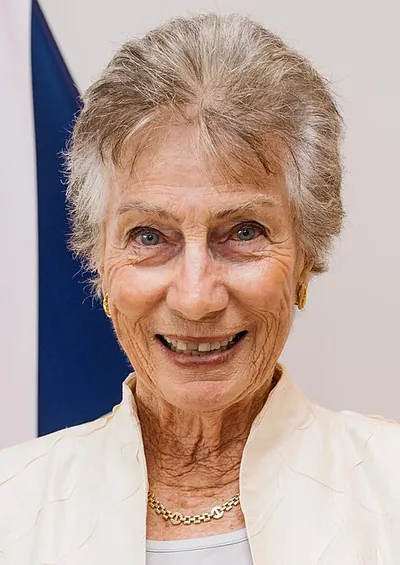 Virginia WadeUnited Kingdom 1945
 Roy EmersonAustralia 1936
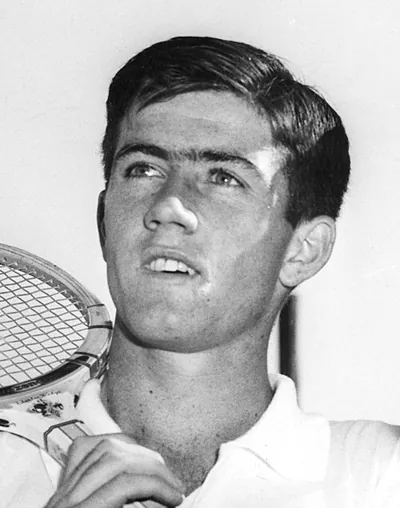 Ken RosewallAustralia 1934
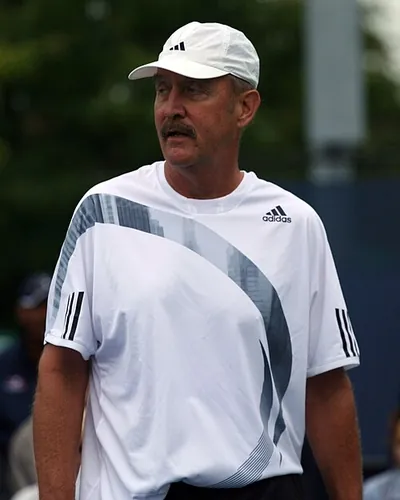 Stan SmithUnited States 1946
 Jan KodešCzech Republic 1946